

Two Focus owners can argue about this for an hour and both be right. Ford fitted timing belts to some Focus engines and timing chains to others, sometimes within the same model year, depending on which engine sat under the hood. The badge on the tailgate tells you nothing. The engine does. Here's how the generations break down, what the intervals look like, and what to do when the book is missing or vague.
The confusion is understandable. Ford used the word "Duratec" on belts and chains alike, sold the same Focus in Europe and North America with completely different engine ranges, and changed its mind more than once about how long a belt should last. A 2008 Focus with a 1.6 petrol and a 2008 Focus with a 1.8 petrol do not share the same answer. Neither do two 2013 cars, one an EcoBoost and one a Duratec. This guide walks through the generations, but treat it as a map rather than a verdict — the final word always belongs to your specific engine code.
Start With the Engine, Not the Year
Ford sold the Focus across four generations and a wide spread of petrol and diesel engines. Several of those engines overlapped between generations, and a few markets got combinations that never appeared elsewhere. Before you buy parts or book labour, spend five minutes confirming exactly what you have.
- Read the maintenance schedule in the owner's manual supplement. It is the only authority for your car, and Ford has revised some of these intervals over the years.
- Find the engine code. It is usually on a sticker on or near the timing cover, and it identifies the engine far more precisely than "1.6 petrol" ever will.
- Check the VIN with a Ford dealer or an online VIN decoder. This confirms the engine fitted at the factory, including any mid-cycle changes.
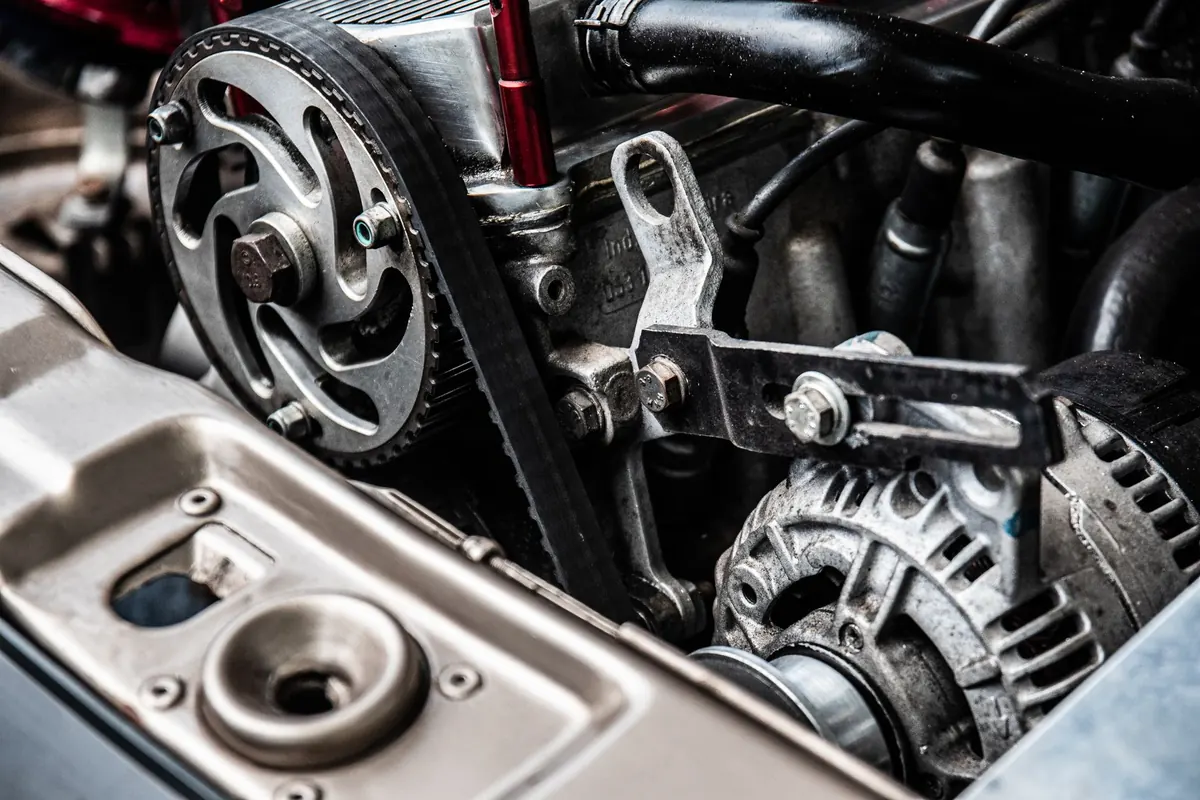
- Look at the front of the engine with a torch. A dry, toothed belt behind a plastic cover and a chain behind a sealed metal cover are two very different pictures.
- Ask for documented proof of any previous cambelt change. A receipt with a part number beats a seller's memory every time.
Belt or Chain? The Generation-by-Generation Breakdown
Focus Mk1 (1998–2004)
The first Focus is belt territory almost across the board. The Zetec-SE 1.25, 1.4 and 1.6 petrol engines (also badged Duratec later on) use a toothed timing belt, as do the Zetec-E 1.8 and 2.0 units, including the Mk1 RS. The 1.8 TDCi diesel runs a belt as well, and the later 1.6 TDCi that arrived towards the end of the run is also belt-driven. Ford's typical guidance was a replacement around every 10 years or 100,000 miles, whichever came first, though earlier printings quoted shorter mileage figures.
Focus Mk2 (2004–2011)
This is where owners start getting caught out. The 1.6 Ti-VCT petrol (a Sigma-derived engine) uses a belt. The 1.8 and 2.0 Duratec HE petrol engines are Mazda MZR-derived and use a timing chain, not a belt — despite sharing the Duratec name with belt-driven relatives. The 2.5 five-cylinder in the ST and RS uses a belt, as do the 1.6, 1.8 and 2.0 TDCi diesels.
Focus Mk3 (2011–2018)
The Mk3 mixes things up again. The 1.0 EcoBoost runs a wet belt — a belt running inside the engine oil. The 1.6 and 1.5 EcoBoost petrols, the 1.6 Ti-VCT, the 2.0 EcoBoost in the ST and the 2.3 EcoBoost in the RS all use conventional dry belts. The 2.0 Duratec HE continues with a chain. On the diesel side, the 1.6, 1.5 and 2.0 TDCi units are belt-driven.
Focus Mk4 (2018–Present)
The newest Focus keeps the pattern: 1.0 EcoBoost and 1.5 EcoBlue diesel wet belts, 1.5 and 2.3 EcoBoost petrols on conventional belts, and the 2.0 EcoBlue diesel on a belt with a chain-driven oil pump in some variants. If you own one of these, the wet belt service is the single most important item on the schedule.
What the Intervals Actually Look Like
Intervals vary by market, engine and the year the manual was printed. These are the figures most commonly quoted, but always confirm against your own documentation:
- Older Zetec and Zetec-SE petrols: roughly 10 years or 100,000 miles.
- 1.8 and 2.0 TDCi diesels: commonly 10 years or 100,000–125,000 miles.
- 1.6 Ti-VCT and 1.6 EcoBoost: often 10 years or 100,000–125,000 miles.
- 1.0 EcoBoost wet belt: Ford originally described it as lifetime, then revised this to around 10 years or 150,000 miles.
- Duratec HE and other chain engines: no fixed replacement interval, but inspection from 100,000 miles onwards is wise.
Never trust the model year alone. The engine code on the timing cover sticker is the only reliable answer to the belt-or-chain question.
The Wet Belt Problem
The 1.0 EcoBoost and 1.5 EcoBlue wet belts deserve their own section because they fail in a way dry belts do not. Sitting in hot oil, the belt slowly degrades and sheds material. That debris can block the oil pump pickup, starving the engine of oil and destroying the turbo or the bottom end before any warning light appears. It is also sensitive to the wrong oil: using a specification other than the one Ford requires accelerates the breakdown.
If you own one of these engines, treat the belt as a service item with a hard deadline. Many independent specialists recommend inspection well before the official interval, and replacement of the belt, tensioner and oil pump assembly together. The job costs more than a conventional belt because the sump and front cover have to come off, but it is far cheaper than an engine.
Chains Are Not Maintenance-Free
A chain does not have a replacement interval, but that does not mean it lasts forever. Chains stretch, tensioners weaken and plastic guides crack. The earliest sign is usually a rattle on cold start that fades as oil pressure builds, followed later by a check engine light or rough running as the camshaft timing drifts. Regular oil changes with the correct specification are the single best thing you can do to keep a chain healthy. If you hear the rattle, get it inspected — a chain and guide kit is expensive, but a jumped chain can bend valves.
Signs Something Is Wrong
- Squealing, chirping or slapping from the front of the engine.
- A rattle on cold start that disappears once warm (chains and tensioners).
- Oil weeping from behind the timing cover.
- Debris or sludge in the oil, or a blocked oil pickup on a wet belt engine.
- Misfires, poor running or a camshaft correlation fault code.
- Coolant loss with no visible external leak, pointing to a failing water pump driven by the belt.
When the Service Book Is Missing
No paperwork is a common problem on older Focuses, and it is not a reason to walk away — but it is a reason to price the job in. Assume the belt is original unless there is proof otherwise. On a car with no history, budget for a belt and water pump as soon as you buy it, then you know exactly where you stand. On a chain engine, budget for an inspection and an oil and filter change, and listen carefully from cold.
On a wet belt car with no history, be more cautious. Ask a specialist to inspect the belt through the oil filler or with the sump off, and if there is any doubt, replace it. The failure mode is sudden and the repair bill is severe.
Costs and Practical Advice
Fitting a cambelt kit with a water pump on a straightforward petrol or diesel Focus is a few hours of labour and a modest parts bill. Expect noticeably more for a five-cylinder ST or RS, and more again for a wet belt job that requires the sump to come off. Whatever the quote, insist on a complete kit — belt, tensioner, idler and water pump — rather than a belt alone. Reusing old tensioners is false economy, and a leaking water pump after a fresh belt means paying for the same labour twice.
Finally, remember that intervals are a maximum, not a target. Short, stop-start town driving, extreme temperatures and long periods of low mileage all age a belt faster than the handbook suggests. If your car spends its life in traffic and rarely covers big miles, bring the change forward rather than stretching it out.
The Bottom Line
There is no single answer to whether a Ford Focus has a timing belt or a chain, and anyone who tells you otherwise is guessing. The Mk1 is almost entirely belt-driven. The Mk2 introduced chains with the Duratec HE. The Mk3 and Mk4 brought wet belts into the picture. Identify your engine code, check the schedule, and if the history is unclear, assume the work still needs doing — then enjoy the car with one less thing to worry about.
Photo: Hebert Santos / Pexels
Related posts
More stories you’ll love reading