An entryway lantern does quiet work. It lights the step where a guest might trip, throws a warm pool across the path, and sets the tone before the door even opens. A vintage fixture makes a house read as established, a little romantic, older than it may be. A modern one makes the same doorway feel crisp and deliberate. Neither wins on principle. The question is which suits your architecture, your weather, and the way you want people to feel when they walk up.
Two Families of Design, Briefly Compared
Vintage lanterns borrow from fixtures built roughly between the late 1700s and the 1930s: hexagonal or square cages, tapered glass, candle-style sockets, scroll brackets, finials, visible hinges. The ornament is part of the point. Modern lanterns strip that away to geometry — straight frames, hidden fasteners, even light, often an integrated LED behind frosted glass. Some modern designs nod to industrial or mid-century shapes, but the guiding idea is restraint.
You can usually tell which family a lantern belongs to in seconds:
- Vintage signals: clear or seeded glass, visible candle sleeves, hand-rubbed or antiqued finishes, decorative caps and finials, exposed hardware.
- Modern signals: frosted or ribbed glass, matte or brushed finishes, seamless corners, concealed bulbs and screws, a single clean silhouette.
Materials: Weight, Weather, and Upkeep
Vintage-styled lanterns tend to be made from solid brass, copper, cast iron, or bronze. They feel substantial on the wall, and solid metals age rather than fail. Brass darkens to a soft brown-gold. Copper moves from penny to chocolate to green verdigris. That patina is the appeal, and also the job: polished brass needs occasional care to stay bright, and copper will do what copper does whether you approve or not.
Modern lanterns lean on cast aluminum, powder-coated steel, and composites. They are lighter, easier to hang, and forgiving of salt air and hard freeze-thaw cycles, which matters near the coast or in a climate that swings hard. One caveat worth knowing: "brass finish" and "solid brass" are not the same product. A plated or painted finish can chip at the corners after a few seasons outdoors, while solid brass can be polished back or simply left to age.
Finishes, Glass, and the Quality of Light
Finish is where the two styles separate most sharply. Vintage lanterns favor living finishes — antiqued brass, hand-rubbed bronze, weathered copper, verdigris — that shift over time and look different in morning and evening light. Modern lanterns favor fixed finishes: matte black, satin nickel, powder-coated white, brushed brass. They look the same in year five as on installation day.
Glass changes the mood more than most people expect. Seeded or water glass softens and scatters light, hiding the bulb and flattering brick and stone. Clear beveled panels throw sharper highlights. Frosted glass gives a calm, even glow with no visible filament, which suits contemporary facades but can look flat against heavily detailed trim. If you want the vintage look with less upkeep, choose a seeded-glass lantern in a brushed finish and use a warm bulb around 2700K — it reads period without the polishing routine.
Scale and Placement Rules That Actually Matter
An oversized lantern on a small porch looks like a mistake. A dainty one beside a tall double door disappears. A few guidelines keep proportions sane:
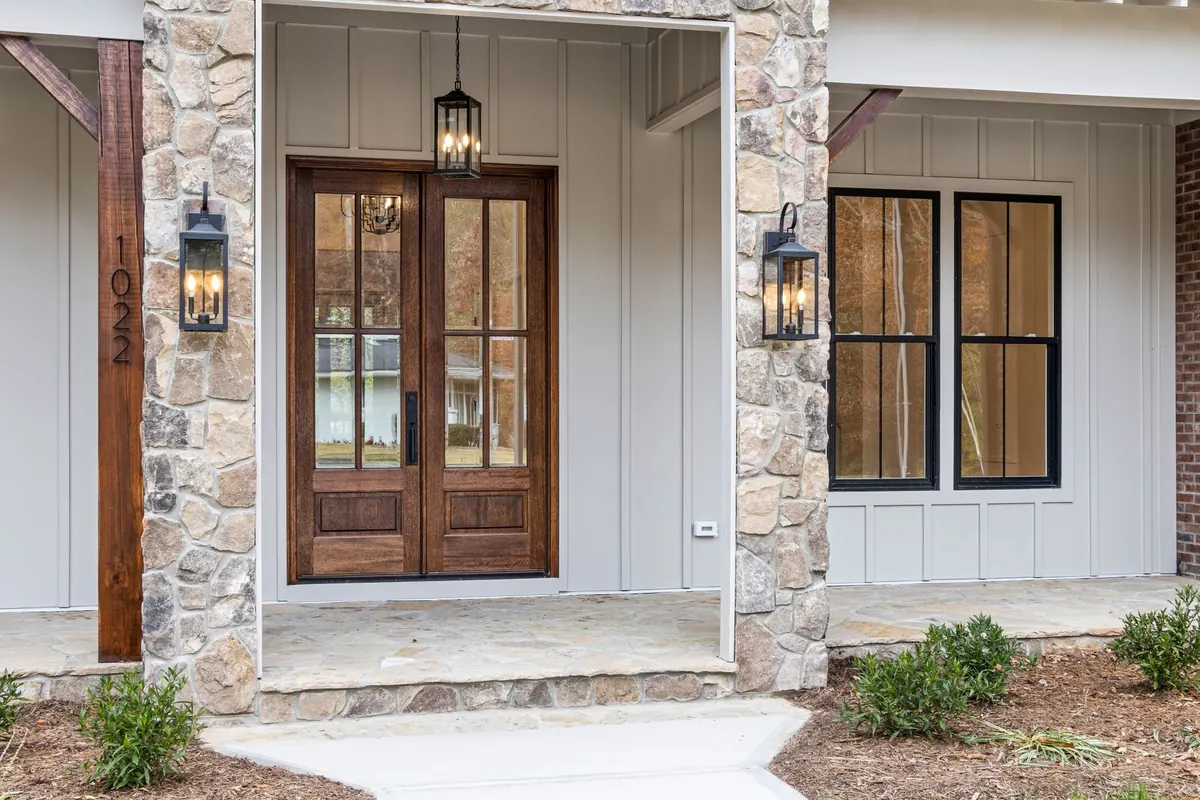
- As a starting point, a wall lantern's height should be roughly one-quarter to one-third the height of the door.
- Mount it so the center sits near eye level, commonly around 66 to 72 inches from the ground, with the bottom just above the door hardware.
- For two flanking lanterns, keep them symmetrical and leave a few inches of wall between the fixture and the door trim so neither crowds the other.
- A hanging porch lantern should clear head height — at least about 6 feet 8 inches of clearance in a walkway.
- Check that the backplate is wide enough to cover the existing junction box, and that the lantern's projection won't clash with a storm door swing.
Also confirm the rating. Damp-rated is fine under a covered porch; an exposed wall that takes direct rain needs wet-rated construction. Anything involving new wiring, moving a box, or adding a circuit is a job for a licensed electrician.
Pairing Lanterns With Your Entryway
Architecture should lead. These pairings rarely disappoint:
- Cottage or farmhouse: aged bronze or copper, tapered seeded glass, a simple curved bracket. Nothing fussy.
- Craftsman bungalow: oil-rubbed bronze in a square frame with amber or clear glass and straight lines that echo the porch columns.
- Colonial or Georgian: solid brass, symmetrical placement, candle-style bulbs. Traditional lanterns and painted shutters belong together.
- Contemporary or new-build: matte black or white, a clean cylinder or box, integrated LED, one lantern each side.
- Industrial loft or converted brick: a black steel cage with an exposed filament-style bulb, sized generously.
- Coastal: powder-coated aluminum or weathered brass, wet-rated, with finishes that tolerate salt.
Mixing the two without a mismatch
You can blend eras if you hold one variable steady. Keep the finish identical across every exterior fixture — door hardware, house numbers, mailbox, and lanterns — and the eye will forgive a modern lantern on an old house or a vintage one on a new build. Or keep the silhouette consistent and vary the material. What looks careless is two different metals on the same wall, or a vintage lantern with a cool-white LED bulb that turns its warm patina gray.
A Checklist Before You Buy
- Measure the door height, the wall space beside it, and the distance from the trim to any sidelight or corner.
- Photograph the existing junction box and note its position, so the backplate will cover it.
- Confirm damp or wet rating for the exact spot the lantern will hang.
- Decide on an integrated LED or a replaceable bulb, and check the socket type and maximum wattage if it's replaceable.
- Ask how the glass is removed for cleaning. Seeded and ribbed glass collects dust and pollen.
- Be honest about maintenance. If you won't polish brass twice a year, choose a finish that ages on its own terms.
- Buy both lanterns in the same order, not one now and one next spring, if a matched pair matters to you.
Making the Choice
Pick the mood first, the material second, the size last. If your house has original details, a vintage lantern usually looks like it has always been there. If the facade is simple and sharp, a modern fixture will look intentional rather than borrowed. Either way, warm light at the door beats a bright white glare every time — and a lantern you enjoy looking at from the driveway is doing its job.
Photo: Curtis Adams / Pexels